It is 10 a.m., you have walked from the car park to the office, and your sock has already collapsed into a soft ring around your ankle. You pull it up. Twenty minutes later it is down again. The sock is not worn out, the shoes are not unusual, and yet nothing stays where you put it.
The fix is almost never to pull harder. Men's socks slide down for three practical reasons: the cuff elastic has lost its recovery, the sock is too short to sit on the widest part of the calf, or fabric weight and shoe friction drag it down with every step. Deal with the cause that applies to you and the sock stays up through a full working day.
We knit socks in Zhuji and talk to retail buyers and to men shopping for themselves all week. The questions are remarkably similar, so here is the short version of what we tell them.
Why men's socks slide down
Before changing anything, identify which failure mode you have. Each one needs a different remedy.
- Cuff fatigue. Elastic yarns relax with heat, detergent residue and time. A cuff that returns slowly after you stretch it will not hold a calf all day, no matter how often you pull it up.
- Wrong length. A mid calf sock on a large calf sits on a narrowing part of the leg. There is little circumference for the cuff to grip, so gravity wins by mid morning.
- Fabric weight and friction. Thick terry or heavyweight wool carries more mass, and a roomy shoe that lets the foot move inside it rubs the sock downward with every stride.
Give the cuff something to hold on to
The single most effective change is length. A cuff needs to sit on or just above the widest part of the calf, where the leg gives it the most fabric to grip. For most men that means 5 to 10 cm above the ankle bone for a mid calf style, and just below the knee crease for an over the calf style.
Cuff position and stay-up performance by sock length. Styles that place the cuff higher on the calf have more fabric and elastic to work with, which is why over the calf designs hold best across a long day.
| Style |
Where the cuff sits |
Stay-up performance |
Typical use |
| Invisible or boat |
Below the ankle bone, inside the shoe |
Lowest, held by heel grip and shoe fit |
Summer, loafers, sneakers |
| Short or ankle |
At or just above the ankle bone |
Low to moderate |
Casual wear, trainers |
| Mid calf crew |
Lower third of the calf |
Moderate, sensitive to calf shape |
Sport, everyday wear |
| Over the calf |
Just below the knee crease |
Highest, reliable over a full day |
Business wear, long hours standing |
| Knee high |
Across the knee crease |
High, but can bunch behind the knee |
Sport, cold weather |
For dress shoes especially, an over the calf cut removes most of the slide before you even adjust the fit. If that is your daily uniform, start with the men's long socks range and treat everything shorter as casual wear.
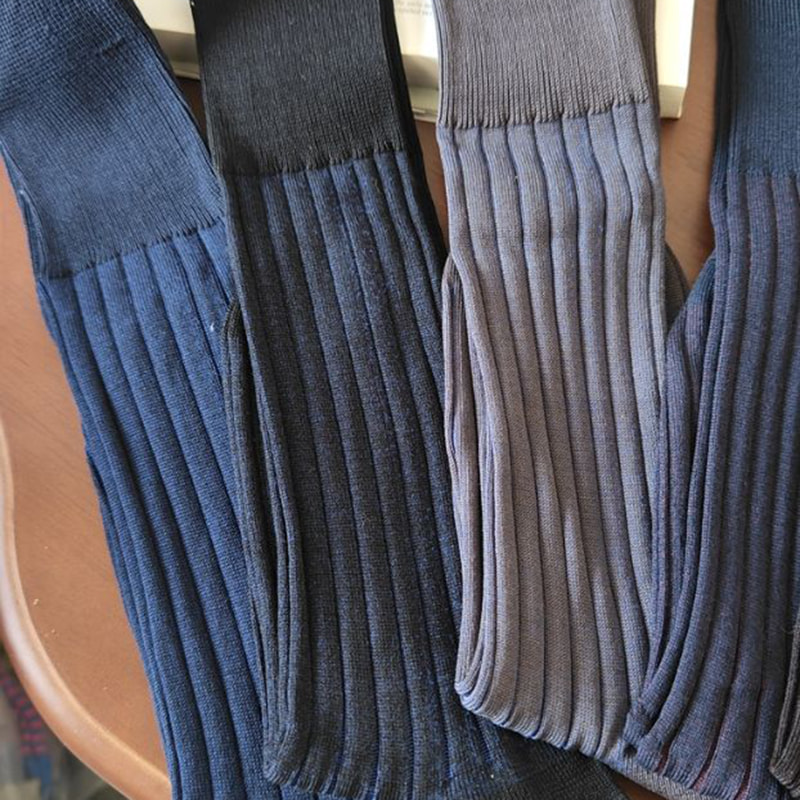 Double Needle Business Football Socks for MenA long over-the-calf option for dress shoes, with double-needle construction intended to keep the cuff denser and hold its shape.View Product →
Construction matters as much as cut. A double needle tube is knitted denser, so the fabric itself resists stretching out, and the cuff keeps its shape after repeated wear instead of turning into a loose band by lunchtime.
What decides whether a cuff recovers
Elastic type and content
Bare spandex is cheap and fades fast. Covered spandex, where the elastic filament is wrapped in nylon, survives washing and repeated stretch far better. A body content of 2 to 4 percent elastane plus a dedicated elastic in the cuff is a sensible benchmark. Below that, recovery drops off quickly and the sock starts creeping down after a few weeks.
Rib structure
A 1 by 1 rib stretches easily and looks neat but has limited grip. A deeper 2 by 2 rib with a taller tuck holds better on a large calf, because the ridge structure gives the cuff more contact area. Cuff height also counts: 4 cm is a practical minimum for a sock that has to stay up under trousers.
Cold weather makes it worse
Heavy winter socks carry more weight, and wool blends have less natural spring than cotton with elastane. Look for a long tube with a knit-in cuff rather than a folded-over top, and make sure the leg length clears the calf rather than stopping halfway up it.
 Woolen Football Stockings for Cold-Weather SportThickened looped long socks for cold-weather exercise, covering the calf and offering warmth, breathability, and optional anti-slip designs.View Product →
Fit the cuff, not just the shoe size
Sock sizing by shoe size alone is where most men go wrong. Two men wearing the same shoe can have calves 8 cm apart, and the sock does not know about either of them. Measure instead.
- Measure the calf at its widest point with a soft tape, standing up, not seated.
- Lay the sock flat and measure the relaxed cuff, then double it. That figure should be roughly 5 to 10 percent smaller than your calf measurement.
- Ask about length before width. If you are between sizes on a large calf, go up in length first, since a taller sock gives the cuff a better landing zone.
- Do a stretch test in the shop. Pull the cuff to about 80 percent elongation and release it. It should spring back within a second or two.
Tolerance matters in both directions. More than roughly 15 percent negative ease leaves red marks and restricts circulation, while a cuff that is barely smaller than the calf will simply slide. Somewhere around 5 to 10 percent is the working window.
Rescue the socks already in your drawer
If the elastic is still alive, care can add months of service. If the cuff has gone soft and stays stretched, no laundry trick will bring it back and the pair belongs in the cleaning rag pile.
- Wash at 30 C or cooler. Hot water is the fastest way to age elastic.
- Skip fabric softener. It coats fibres and reduces the grip a cuff needs to hold a calf.
- Air dry flat instead of using a hot tumble dryer, which degrades spandex quickly.
- Rotate pairs so each one gets a full recovery day between wears.
- For formal dress socks, a simple elastic garter under the trouser leg is a practical and invisible backup.
Our care and maintenance recommendations for men's socks cover washing, drying and storage in more detail.
When the sock slips off the heel instead
A different failure mode, and a common one with low cut shoes. If the sock is fine at the cuff but rolls off the back of your heel, the problem is shoe fit and heel grip rather than leg length. A silicone strip inside the heel, a slightly deeper cut and a shoe that does not let the foot slide forward all help.
 Fine-Gauge Silicone Anti-Slip Men’s Invisible SocksOne-piece no-show socks in fine 200-needle knitting, with a silicone heel grip to help them stay put in low-cut shoes.View Product →
Fine gauge knitting, around 200 needles, produces a thinner, denser fabric that sits flat under the heel instead of bunching, which is the detail that stops the roll in the first place.
A checklist for wholesale and private label orders
For buyers, stay-up performance is a specification rather than an opinion, and it can be written into a purchase order. Ask suppliers for these points before signing off a sample.
- Elastic type and percentage, stated separately for the body and the cuff.
- Rib structure, cuff height and needle count on the machine used for production.
- Elongation and recovery figures, for example 80 percent stretch with recovery above 90 percent.
- Wash test results after three to five cycles at 40 C, with cuff measurements before and after.
- A wear trial on at least two calf sizes, not just one fit model.
- Colour and elastic consistency across dye lots, so pair ten performs like pair one.
Most sagging socks are not a mystery. They are a cuff that has given up, a length that puts the cuff on the wrong part of the leg, or too much weight and friction for the elastic to fight. Check the stretch of the cuff you already own, measure your calf once, move your dress socks to an over the calf length, and wash them cool. The morning tug under the desk disappears, and you stop noticing your socks at all, which is exactly how a good pair should behave.



 English
 中文简体
 Español