The best way to fold long men's socks is to fold them in thirds, keep the cuff flat, and tuck the toe end under the cuff band only when the band still has slack. That simple fold-and-tuck approach suits over-the-calf business socks, knee-high football socks and wool blends. A loose roll is better for travel, while a flat file fold is easier to live with in a drawer. The method to avoid is the tight ball, because it compresses the elastic cuff and presses hard creases into the knit.
Long socks behave differently from ankle socks. There is more fabric between the heel and the cuff, so folding them in half creates a bulky bundle. The cuff also does more work: it has to hold the sock in place without pinching. If the top band is stretched during folding, the sock may slide down later. A good fold keeps the pair together, protects cuff recovery and lets the sock sit flat between wears.
Choose the Fold Based on Sock Type and Storage
Before folding, pair socks by toe shape, heel position and cuff height. Long socks can look the same at the cuff but differ at the heel. Socks should be clean and fully dry; damp cotton or wool folded into a tight bundle can hold odor and weaken elastic. The table below gives a quick comparison; the sections that follow explain the details.
Four folding approaches and the main trade-off for long men's socks.
| Method |
Best for |
Basic steps |
Watch point |
| Fold and tuck |
Over-the-calf, knee-high, business and football socks |
Fold in thirds and tuck the toe end under the cuff |
Keep the cuff relaxed |
| Loose roll |
Travel, gym bags and short-term storage |
Roll from toe to cuff and tuck the cuff over the roll |
Do not roll damp or thick wool tightly |
| File fold |
Drawers, retail shelves and daily rotation |
Fold flat in thirds and stand the pair upright |
Avoid heavy stacks that crush the cuff |
| Half fold |
Short socks and quick tidy-up |
Fold heel to cuff once |
Long socks become bulky |
For most long men's socks, fold and tuck gives the best balance. It is compact enough for a drawer, stable enough for a shelf and gentle on the cuff.
The Fold-and-Tuck Method for Long Men's Socks
This method works because it turns the sock's own length into a soft pocket. It keeps the pair matched without a rubber band, clip or knot.
- Place one sock on top of the other and align the toe, heel and cuff. Smooth out twists, especially around the heel and ribbed band.
- Fold the toe section up to the heel line. Press lightly with your palm; do not pull the fabric.
- Fold the foot section up toward the cuff and stop about 2 cm below the cuff band. That gap gives the elastic room to relax.
- Tuck the toe end under the cuff band if there is enough slack. If the cuff feels tight, leave the bundle untucked and lay it flat.
The cuff should look smooth, not stretched. If you see a deep dent or the ribbing looks shiny, the fold is too tight. Open it and start again with a flatter fold.
For daily business wear, a flat double-needle knit with a firm but not tight cuff is easier to keep in shape in a drawer.
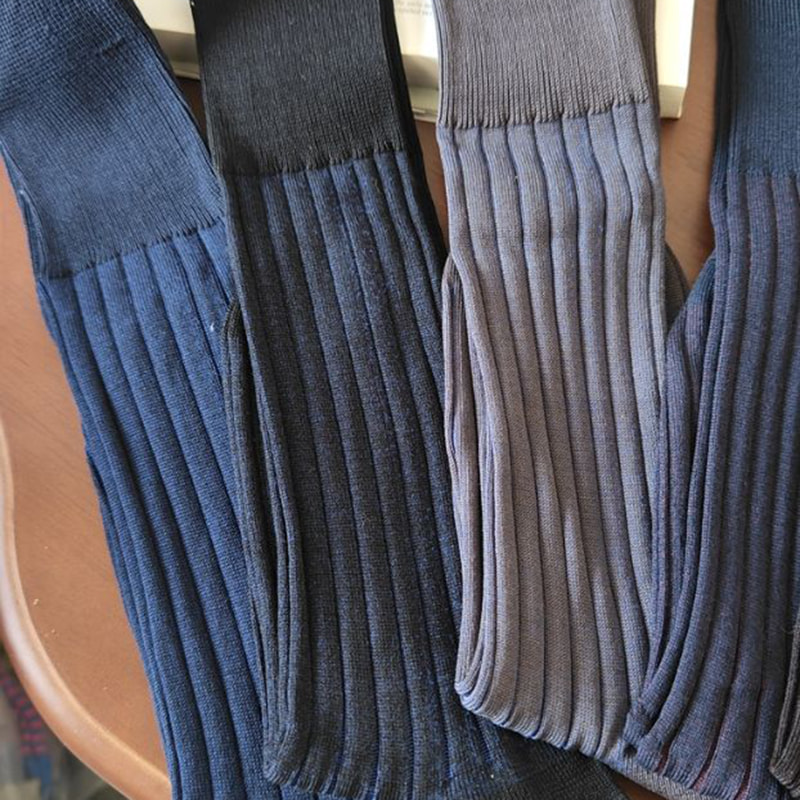 Double Needle Business Football SocksA flat double-needle knit men’s long sock for business wear, with a firm cuff that helps hold shape in drawer storage.View Product →
This fold also works for team socks, but thick football socks may need the looser version described below.
Thick Wool, Football and Looped Socks
Thick long socks need air and space. Woolen football stockings, looped sports socks and brushed winter socks have pile or raised loops on the inside. A tight roll compresses that structure, and the sock can feel flatter and less warm after months in storage. Fold thick socks in thirds without tucking, or roll them loosely from toe to cuff. Store them near the top of the drawer so the weight of other clothes does not press the pile.
 Woolen Football Stockings for Cold-Weather ExerciseLooped, thickened men’s long socks for cold-weather football, with calf coverage; store them loosely so the plush structure is not compressed.View Product →
For wool blends, let the sock rest flat after washing and make sure it is completely dry before folding. Never hang a long sock by its cuff for days; gravity pulls the elastic out of shape. A breathable cotton bag is better than a vacuum bag for seasonal storage. If space is tight, stack thick socks in a single layer and avoid pressing them under heavy items.
Drawer Storage and Travel Packing
File folding is the best default for a drawer. Fold each pair flat in thirds and stand it upright so the cuff is visible. This makes matching easy and prevents the pile of socks from turning into a loose heap. Use dividers or a shallow box, but avoid tight elastic bands; they leave permanent dents in the cuff. In a retail display or sample room, the same upright fold shows the cuff shape and leg length clearly.
 Rainbow Striped Looped High-Tube Long SocksBright rainbow-striped men’s long socks with looped fabric for warmth and breathability; high-tube styles cover the calf and suit travel or drawer storage.View Product →
For travel, roll from toe to cuff and tuck the cuff over the roll. Place the roll in a packing cube or a shoe bag, not under shoes or a laptop. On arrival, unroll the socks and let them relax before wearing. A looped high-tube sock takes more space than a thin business sock, so pack those pairs separately and do not force them into a tight corner.
Common Folding Mistakes That Shorten Sock Life
Most sock damage in storage comes from compression, moisture and tension, not from the sock being old. Watch for these habits:
- Balling a pair tightly and wrapping a rubber band around it. This stretches the cuff and leaves hard creases.
- Turning the cuff inside out to keep the pair together. The ribbing is pulled in the wrong direction.
- Folding socks that are still damp. Moisture can encourage odor and weaken elastic over time.
- Stuffing long socks into a full drawer. Constant pressure flattens the cuff and compresses wool pile.
- Hanging socks by the cuff. The weight of the leg pulls the elastic band out of shape.
Folding is only one part of sock care. Washing inside out, avoiding high heat and giving cuffs time to recover between wears will do as much for fit as a neat drawer. This care and maintenance guidance for men's socks covers washing and drying points that pair well with the folding routine above.
What to Look for in Long Socks That Fold Cleanly
Not every long sock folds well. Cuff construction matters more than thickness. A balanced ribbed cuff with enough elastane returns to shape after folding; a very tight cuff can leave marks, while a very loose cuff slides down. For bulk buyers, ask for cuff recovery after repeated stretch, check that toe seams lie flat, and confirm leg length after washing. A shaped heel helps because it gives the fold a natural line. Straight tube socks can work, but they need a flatter fold to avoid bulk.
Material also affects storage. Cotton and cotton-rich blends suit daily business socks, wool blends hold warmth for football and winter wear, and durable synthetic blends work for training. BoLong Socks produces men's long socks in business, football and looped styles, with in-house steps covering design, knitting, setting, quality inspection and packing. For a bulk order, test a sample pair with the fold you plan to use in storage or retail. A fold that works in a warehouse may look different in a gift box.
Use fold and tuck as the default for over-the-calf and knee-high socks. Switch to a loose roll for travel and a flat file fold for drawers. Leave the cuff unstretched, keep socks dry, and do not store them under compression. A well-folded pair should look compact, feel soft at the edge and sit in the drawer without a hard crease.
If a fold leaves a deep line across the cuff, it is too tight. Open it, smooth the sock and try a flatter fold. The best method is the one that keeps the pair together, protects cuff recovery and fits the storage space without forcing the sock into a tight shape.



 English
 中文简体
 Español