The usual name for men's high socks is knee-high socks when the cuff sits just below the knee. A more precise menswear term is over-the-calf socks, especially for business and dress styles. Long socks is the broad trade term, and it can cover several lengths, so it is useful in conversation but weak on a purchase order.
That is why the same pair can appear as knee highs, over-the-calf socks, high tube socks, or long business socks. The label changes with the end point, the intended use, and the way a seller organizes its range. If you need the short answer, use knee-high socks for the retail name and over-the-calf socks when fit and precision matter.
Knee-High and Over-the-Calf: The Main Names
Knee-high socks end at or just below the knee. The cuff should sit comfortably without digging into the back of the knee, and the sock should stay up during walking, standing, and sitting. In menswear, over-the-calf is often the better term because the sock should cover the calf and stay below the knee without pulling. The two names overlap in everyday use, but over-the-calf says more about where the sock stops and how it fits.
What the cuff position tells you
If the cuff sits at mid-calf, the item is a mid-calf sock rather than a high sock. If it covers the calf and stops below the knee, over-the-calf is accurate. If it reaches the knee, knee-high is the familiar retail term. If it rises above the knee, it becomes a thigh-high sock. Those are different products with different fit needs, even if all of them look tall when folded on a shelf.
Why sellers use more than one name
Retail listings often choose words that shoppers search for, such as knee-high socks, long socks, or high socks. Factories and wholesale buyers tend to use terms that can be measured, such as over-the-calf, mid-calf, and knee-high. A good product description uses both. It gives the familiar name first and then states the measured length, size range, and cuff style so the buyer knows what will arrive.
A Quick Guide to Men's High Sock Names
The table below shows the terms that cause the most confusion. The end point matters more than the word high, because a tall sock for casual wear and a tall sock for formal wear can have different cuffs, materials, and toe finishes.
Men's high sock names by length, use, and buying risk.
| Term |
Typical end point |
Common use |
What to check |
| Knee-high socks |
Just below the knee |
Dress, casual, school, sport |
Cuff recovery and back-of-knee comfort |
| Over-the-calf socks |
Over the calf and below the knee |
Business, formal, travel |
Stays up without pinching or twisting |
| Mid-calf socks |
Mid-calf |
Casual, hiking, work |
Not a true high sock in most ranges |
| Crew socks |
Lower calf |
Everyday wear |
Often sold as crew, not knee-high |
| Tube socks |
Tall, often without a shaped heel |
Casual, vintage, sport |
Fit is less precise than shaped socks |
| Football or soccer socks |
Knee-high |
Sport |
May include padding and a tighter fit |
| Thigh-high socks |
Above the knee |
Fashion, performance, costume |
A different category from men's knee-high socks |
| Long socks |
Broad term |
Retail search term |
Too vague for a production spec |
Use the table as a starting point, then confirm the length with a tape measure. A knee-high sock for a large shoe size is not simply a scaled-up version of a smaller sock. The leg length, calf fit, and cuff tension all change, and those details affect whether the sock stays in place.
Terms That Sound Similar but Are Not the Same
Several sock names describe use or construction rather than height. That is why a search for high socks can return items that do not match the same need.
- Crew socks. A crew sock usually ends around the lower calf. It can be a good everyday sock, but it is not the same as a knee-high sock.
- Dress socks. Dress socks describe a formal or business use. They can be crew height or over-the-calf height, so the word dress does not answer the length question.
- Tube socks. Tube socks describe a construction, often with a straight tube shape and little or no shaped heel. They can be tall, but the fit is usually less precise than a shaped knee-high sock.
- Soccer socks. Soccer socks, also called football socks, are usually knee-high and may include padding, compression zones, or a specific cuff for shin guards.
- Compression socks. Compression is a performance feature. A compression sock can be knee-high, calf-length, or another height, so check the product details rather than the short name.
- Thigh-high socks. These rise above the knee. They are not the same as men's knee-high or over-the-calf socks, even if the product photos look similar when the sock is folded.
Fit Details That Matter More Than the Label
Two socks can both be called over-the-calf and still feel very different. One may stay up all day, while another may slide down or leave a mark below the knee. The difference usually comes down to three details.
Length and size range
Length should be measured from the heel to the top of the cuff, not from the toe. Relaxed length and stretched length both matter, because cotton, wool blends, and synthetic blends behave differently after finishing. A sock that measures correctly on the table may still sit lower on the leg after washing if the cuff loses recovery.
Cuff tension and recovery
A good over-the-calf sock grips the calf without pinching. The cuff should recover after stretching and should not rely on tight elastic to stay up. For business socks, a flat, smooth cuff is often more comfortable under trousers. For sport socks, a firmer cuff can be useful, but it still needs to avoid restricting circulation.
Material and cushioning
Combed cotton gives a smooth surface for dress socks. Wool blends add warmth and moisture handling for cooler weather. Terry-loop cushioning improves comfort in sport and work socks, but it can make a dress sock feel too bulky. The toe seam and heel shape also affect comfort, especially in close-fitting shoes.
- Check the cuff for marks or pressure after ten minutes of wear.
- Confirm that the heel sits under the heel, not halfway up the ankle.
- Look for a flat toe seam in formal styles.
- Allow for shrinkage and recovery after the first wash.
Matching the Sock to the Use Case
For business and formal wear, look for over-the-calf socks with a smooth finish and a cuff that stays up without pinching. A double-needle business football sock is one factory term for a tall, shaped men's sock with a denser knit and a clean finish.
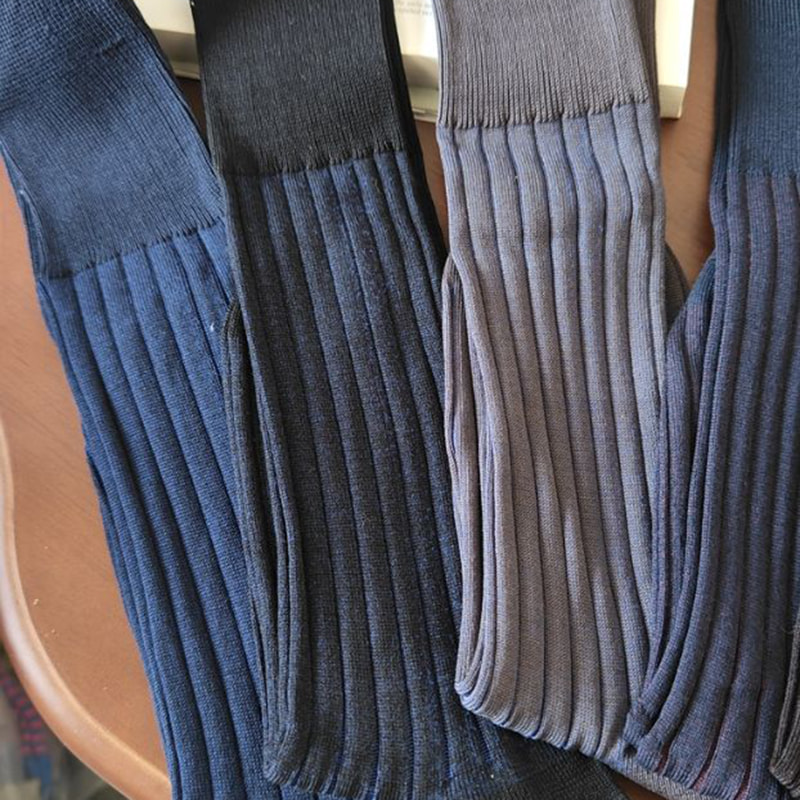 Double Needle Business Football Socks for MenA tall men's sock with double-needle construction, positioned for business or football-style wear and noted for durability, clearer patterns, and breathability.View Product →
For sport, knee-high football or soccer socks need to hold shin guards, manage moisture, and cushion impact. A woolen football stocking can suit cooler conditions, while a lighter cotton or synthetic blend may be better for warm weather and repeated washing.
 Woolen Football Stockings for Cold-Weather SportLong-tube soccer socks with looped plush construction for warmth, calf coverage, moisture management, and optional anti-slip stability during cold-weather exercise.View Product →
For casual wear, high tube socks and striped long socks offer a different look from formal over-the-calf styles. The cuff can be softer, and the knit can be heavier, but the same rule applies. The sock should stay at the intended height without constant pulling.
 Rainbow Striped High-Tube Looped Long SocksColorful high- or long-tube socks with looped fabric for warmth, breathability, and soft comfort, suited to casual wear and different calf or thigh coverage needs.View Product →
If you are comparing lengths, the men's long socks category is a practical place to see how factories group knee-high, over-the-calf, and casual high-tube styles.
What to Put on a Bulk Order Spec Sheet
For a factory order, the name is only the start. A clear spec sheet prevents the common problem where one side expects a knee-high sock and the other produces an over-the-calf sock with a different cuff height.
- End point and measured length. State whether the cuff should sit just below the knee, over the calf, or at mid-calf. Give the measured length from heel to cuff in centimeters.
- Size range. List shoe sizes and calf fit separately. A wide calf may need a different cuff or knit rather than a longer sock.
- Cuff stretch and recovery. Ask for the relaxed and stretched cuff measurements, and confirm that the cuff will recover after wear.
- Yarn and needle count. Specify the fiber blend, such as combed cotton, wool blend, or synthetic blend, and the needle count if the hand feel and density matter.
- Toe, heel, and cushioning. Confirm whether the toe seam should be flat, whether the heel is shaped, and whether the sole needs terry-loop cushioning.
- Color and packing. State the color standard, size stickers, poly bag or box packing, and the number of pairs per carton.
Small tolerances matter in this category. A difference of one or two centimeters at the cuff can change the name from knee-high to over-the-calf, and it can change how the sock feels under trousers or sports kit.
So, what do you call men's high socks? Most people mean knee-high socks, but over-the-calf is the more useful term when you care about where the sock stops and how it stays up. Long socks is fine for a general search, and dress socks and soccer socks describe use rather than height. Once you know the end point, the size range, and the cuff behavior, the label becomes much easier to choose with confidence.



 English
 中文简体
 Español