A customer picks up a men's crew sock, folds the cuff between two fingers and asks the same question every season: is this a long sock or a short one? The answer depends on what you compare it with. Next to a no-show or an ankle sock, a crew sock is clearly long, because it climbs above the ankle bone and covers the lower calf. Next to a dress sock or a football sock, it sits in the middle of the range. In the sock trade, the label long socks usually belongs to over-the-calf and knee-high styles that cover most or all of the calf, while crew stops at mid-calf, roughly two to four inches below the crease behind the knee.
That distinction matters more at the point of purchase than in a dictionary. Length decides whether skin shows when you sit down, whether the cuff stays up inside a boot, and whether a pair still grips the calf after a season of washing instead of sliding into the shoe.
What Crew Length Actually Measures
Length in socks is not the length of the tube lying flat on a table. It is the distance from the heel to the top of the cuff when the sock is worn, and for men's crew socks that distance normally falls between 7 and 10 inches, or about 18 to 25 centimeters. Standing with bare legs, the cuff sits around the middle of the calf and leaves four to six inches of bare skin before the knee. Sit down and the same cuff rises slightly as the calf muscle flattens, which is why crew socks look longer in a chair than in a mirror.
Three things move that number. Shoe size comes first, because the same crew pattern on a size 13 foot sits lower on the calf than on a size 8, as a taller calf stretches the leg of the sock. Knit structure comes second, since a ribbed cuff with two to five percent elastane can climb half an inch higher than a flat knit. Washing comes third, and a cotton crew that shrinks four percent in a hot wash ends the season shorter than a pre-shrunk pair.
Typical cuff heights measured from heel to cuff top on a men's size 9 to 12 sock; stretch and shrinkage can shift each figure by about half an inch.
| Sock style |
Heel to cuff top |
Where the cuff sits |
Common use |
| No-show or invisible |
Under 2 in (5 cm) |
Hidden inside the shoe |
Summer sneakers, fashion |
| Ankle or low cut |
3 to 4 in (8 to 10 cm) |
At the ankle bone |
Light training, casual wear |
| Quarter or short crew |
5 to 6 in (13 to 15 cm) |
Just above the ankle |
Running, golf, walking |
| Crew |
7 to 10 in (18 to 25 cm) |
Mid-calf, 2 to 4 in below the knee |
Everyday wear, school, sport, work |
| Mid-calf dress |
10 to 12 in (25 to 30 cm) |
Upper calf |
Suits, formal occasions |
| Over-the-calf |
12 to 16 in (30 to 40 cm) |
At the knee or just below it |
Business wear, travel, compression |
| Knee-high |
14 to 18 in (35 to 45 cm) |
At or over the knee |
Football, hiking, deep winter |
Why Trousers, Shoes and Posture Change the Answer
Two men of the same height can wear identical crew socks and reach opposite conclusions. The trouser hem decides most of it. A full break that rests on the shoe covers the top third of the sock, so only a sliver of crew length is visible while standing, and about an inch of bare calf appears when seated. A cropped or tapered hem with a short inseam leaves the whole cuff on show, and that is when crew reads as a long sock.
Shoes matter just as much. A low sneaker with a 3 inch collar leaves four to six inches of sock visible, which is most of a crew. A boot with a 6 inch shaft swallows the cuff completely, so crew and over-the-calf look almost identical from the outside, and the only difference you feel is the extra fabric around the calf. Posture adds the final adjustment, since crossing your legs pulls the hem upward and exposes the gap between cuff and knee. That is the moment most people decide whether their socks are long enough.
For anyone who spends the day on their feet, this is not purely a style question. A cuff that sits above the boot line stays where it was put, while a cuff that ends inside the boot rolls down and bunches under the heel.
Where Crew Length Works Best in Practice
Training and sport
Crew is the default length in the gym for a practical reason. It shields the lower calf from bar contact during deadlifts, keeps calf sleeves and shin guards in place, and stays above the heel through a deep squat. A towel bottom or terry loop foot adds cushioning without changing the cuff height, which is why that construction is common in running and training styles. Indoors, a combed cotton crew with a mesh panel on the instep breathes better than a solid knit of the same height.
Everyday wear and work
With trousers that have a slight break, crew is a safe choice and is far easier to find in plain colours than over-the-calf. On a factory floor or behind a shop counter, the practical difference between crew and quarter is coverage. A crew keeps dust, drafts and cold air off the ankle, while a quarter sock leaves it exposed. For most wearers across a mild to cool day, a mid-weight crew covers the whole working shift.
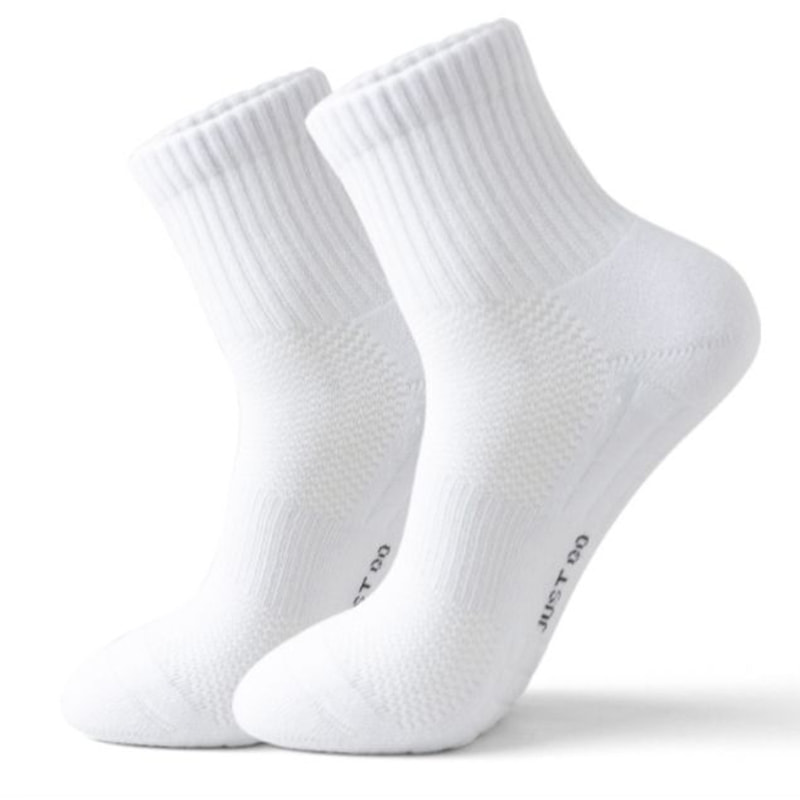 Men's Mid-Length Cushioned Running Socks with Towel SoleThese men's mid-length running socks pair a towel-textured sole for moisture absorption and cushioning with breathable mesh for spring and autumn sports.View Product →
When Crew Is Too Short for the Job
Three situations make crew stop being long enough. The first is formal wear, where a suit trouser with a clean break exposes the calf the moment you sit, and over-the-calf socks are knitted to stay up all day rather than sliding down. The second is cold weather travel, where a longer leg traps warmth and closes the gap between trouser and boot. The third is field sport and hiking, where knee-high socks hold shin guards in place or support the calf on long descents.
If your routine includes any of those, treat crew as a second layer rather than a replacement. Buy crew for the days that end at the office or the gym, and keep two or three pairs of longer socks for the days that do not.
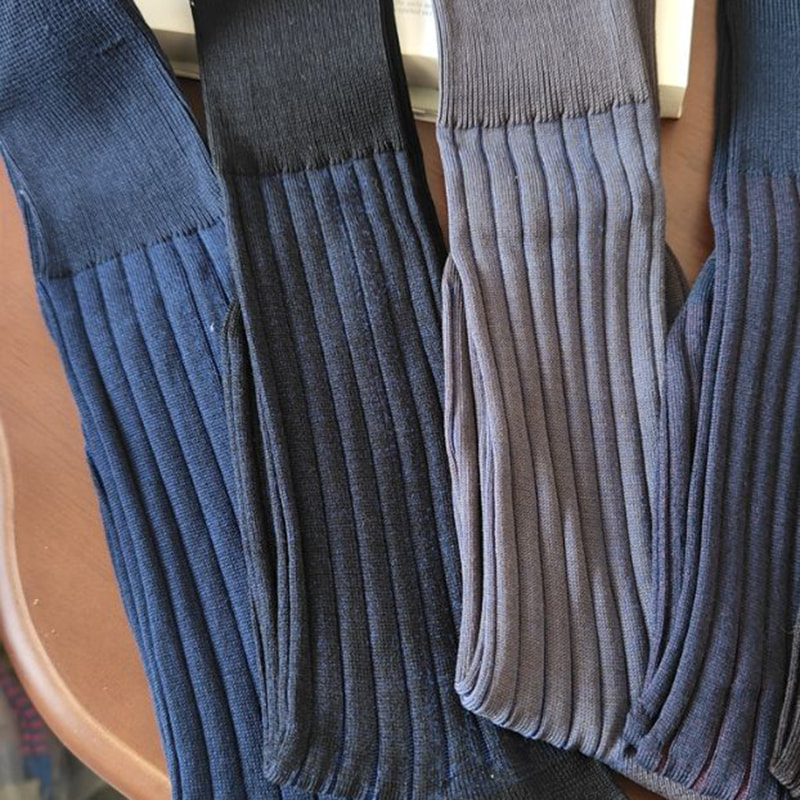 Double-Needle Business Football Socks for MenMen's long business football socks for days when crew coverage is not enough, using double-needle weaving for durability, breathability and dryness.View Product →
Cold Weather, Warmth and Fabric Choice
Length and warmth are separate decisions, and mixing them up is the most common buying mistake. A crew sock can be thin enough for August or thick enough for January, because warmth comes from yarn, loop height and knit density rather than from cuff height. Brushed and looped knits trap air against the skin, wool blends hold warmth when damp, and a plain combed cotton crew still feels cold on a concrete floor even though it covers the calf.
For winter, look at three numbers: the loop height at the sole, the yarn count in the leg, and the elastane percentage in the cuff. A brushed interior with a raised loop under the foot gives warmth without bulk inside the shoe, and a cuff with three to five percent elastane grips the calf without leaving a deep mark. Between seasons, one mid-weight crew in combed cotton handles a heated office and a cold commute on the same day.
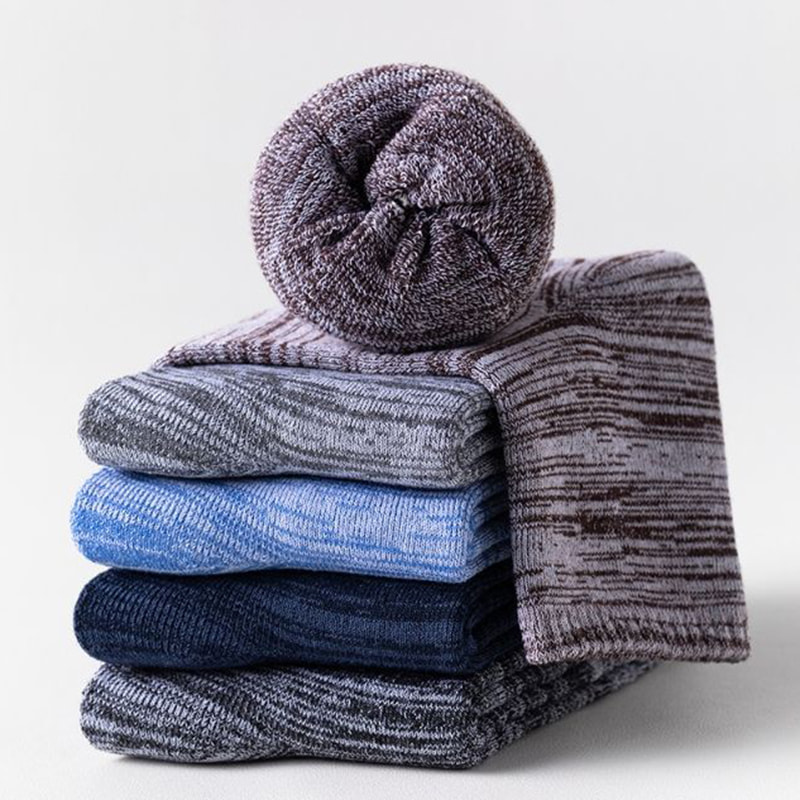 Men's Thickened Looped Warm Mid-Length SocksA men's mid-length sock with thick looped inner surface for winter warmth, moisture-wicking breathability and elastic cuffs that stay comfortable.View Product →
What to Check Before You Buy or Reorder
Sizing and the heel pocket
Men's sock sizing is built on shoe ranges, most often 6 to 8.5, 9 to 12 and 12 to 15, each with a matching foot length. The measurement that matters most is heel pocket placement. If the heel sits too high, the cuff drops toward the shoe; if it sits too low, the cuff crowds the calf. A quick look at men's mid-length socks shows how often a 7 to 10 inch cuff is paired with several different foot lengths, so always order by range rather than by a single shoe size.
Cuff tension, shrinkage and tolerances
For bulk orders, three tolerances tell you whether a supplier understands the product. Cuff height should hold within a quarter inch across a production run, or pairs from the same carton will look different on a shelf. Shrinkage after three home washes at 40 degrees Celsius should stay under five percent, otherwise the sock finishes its life as a quarter sock. Elastic recovery should return within about five percent after repeated stretching, which is what keeps a crew cuff above the boot after fifty wears instead of five.
Care that keeps the cuff where it belongs
Wash crew socks inside out in cold or lukewarm water, skip fabric softener because it coats the elastane, and dry them flat or on a low setting. Roll the sock over the toes when putting it on instead of dragging it up by the top edge, and the ribbing keeps its grip. Detailed care and maintenance recommendations for men's socks are worth a quick read if you want a pair to last a full season.
So, are men's crew socks long? Yes in daily use, because they cover the ankle and the lower calf, and no in factory terms, because the trade reserves long socks for over-the-calf and knee-high styles. The practical test takes ten seconds. Sit down, cross your legs and look at the gap between the cuff and the trouser hem. If skin appears where you do not want it, go longer. If the cuff rolls inside the boot, go shorter or check the heel pocket. Length is a fit decision, and the right answer is the one that stays in place from morning to evening.



 English
 中文简体
中文简体 Español